Water is the number one enemy of Michigan property. Whether you’re dealing with a soggy field, a washed-out driveway, standing water that won’t drain, or a ditch that’s grown in past the point of usefulness — these aren’t aesthetic problems. They’re structural ones. Left alone, poor drainage and inadequate water management quietly damage property value, compromise soil health, and turn usable land into a seasonal headache.
This guide covers three of the most important excavation services Michigan landowners ask us about: drainage tile installation, ditching, and driveway repair. If you’re dealing with any of these issues on your property, here’s what you need to know.
Why Excavation and Drainage Matter in Michigan
Michigan’s climate is hard on land. Freeze-thaw cycles happen dozens of times each winter. Spring snowmelt dumps enormous volumes of water into soil that’s still partially frozen. Summer storms can drop several inches of rain in hours. And Michigan’s soil composition — ranging from heavy clay in many areas to sandy loam further north — handles that water very differently depending on where you are.
The result is that drainage problems are extremely common across mid-Michigan properties. And the longer they go unaddressed, the more expensive the fix becomes.
Drainage Tile Installation
Drainage tile is one of the most effective and long-lasting solutions for persistent wet areas, saturated fields, and chronic standing water. Despite the name, modern drainage tile isn’t clay tile at all — it’s a system of perforated plastic pipe buried underground that collects excess groundwater and carries it away from problem areas.
How Drainage Tile Works
A drainage tile system intercepts water before it becomes a problem at the surface. Perforated pipe is installed below grade, surrounded by gravel, and pitched to direct water toward a designated outlet — a ditch, a pond, a creek, or another appropriate discharge point. As groundwater saturates the surrounding soil, it finds its way into the perforated pipe and flows out of the area.
When Drainage Tile Is the Right Answer
Drainage tile is typically the right solution when:
- Fields or yard areas stay wet long after rainfall
- Certain areas of your property never fully dry out
- Wet conditions are limiting agricultural use or equipment access
- Water consistently moves toward a structure or foundation
- You’re converting wet ground to productive food plot, pasture, or buildable land
What to Expect During Installation
Drainage tile installation involves trenching — typically with a specialized tile plow or excavator, depending on depth and soil conditions. The pipe is placed, gravel is backfilled around it, and the trench is closed. Depending on the scope, a system might involve a single run of pipe or a more complex network designed to address multiple wet areas across a larger property.
At Mac’s Timber & Terra, we assess the slope, soil type, and water sources before designing a system — because a drainage tile system that’s poorly designed or incorrectly pitched won’t solve the problem.
Ditching
A properly maintained ditch is one of the most underappreciated tools a Michigan landowner has. Roadside ditches, field perimeter ditches, and property-line drainage swales all serve a critical purpose: they channel water off of land that would otherwise hold it.
The problem is that ditches require maintenance. And in Michigan, a few growing seasons are all it takes to turn a functional drainage ditch into a clogged, overgrown, ineffective mess.
What Ditching Involves
Ditching is the process of cutting, cleaning, or restoring a drainage channel. This might mean:
- New ditch construction — cutting a drainage channel in an area that needs one for the first time
- Ditch cleaning — removing years of accumulated sediment, debris, and vegetation growth that has reduced or eliminated the ditch’s capacity
- Ditch reshaping — regrading the banks and floor of an existing ditch to restore proper slope and flow
Why Ditches Fail
Most ditch problems come down to a few things: vegetation growth that restricts water flow, sediment accumulation that fills in the channel over time, and collapsed banks that choke the ditch closed. Michigan’s active growing season accelerates all of these.
A clogged or overgrown ditch doesn’t just fail to drain — it can actively hold water against your property and create worse conditions than if no ditch existed at all.
How Often Should Ditches Be Maintained?
It depends on the site. High-sediment areas near cultivated fields may need attention every few years. More stable roadside ditches in established areas might go longer. The honest answer is: if you’ve never had your ditches cleaned, they probably need it.
Driveway Repair and Installation
Michigan is one of the hardest climates on driveways in the country. The freeze-thaw cycle — which can happen 30 to 50 times in a single winter across mid-Michigan — works like a slow demolition crew on any driveway that wasn’t built with the right base from the start.
Gravel driveways heave, rut, wash out at the edges, and develop drainage problems. Even well-built drives need periodic attention as frost, traffic, and time take their toll.
Common Driveway Problems We See in Michigan
- Rutting and soft spots — usually a sign of insufficient base depth or poor drainage beneath the surface
- Washouts and edge erosion — water running along the driveway surface with nowhere to go
- Potholes and settlement — base failure or frost heave pushing material up and creating voids
- Standing water — improper crown or grade causing water to pool instead of draining away
What Proper Driveway Repair Involves
A driveway repair that actually lasts isn’t just a matter of dumping fresh gravel on top of existing problems. Doing it right means addressing what’s happening underneath.
Depending on the condition, that might involve:
Regrading — restoring proper crown and slope so water sheds to the side rather than pooling or running down the center.
Base repair — excavating soft or failed sections and rebuilding with compacted aggregate from the subgrade up.
Drainage improvements — installing culverts, cleaning existing culverts, or adding drainage features at problem areas where water is collecting.
Material addition — once the base and grade are right, the right material in the right depth gets applied and compacted properly.
The Michigan Factor: Why Base Depth Matters
Michigan soil — particularly clay-heavy soils common across Genesee, Lapeer, and surrounding counties — moves significantly with frost. A driveway base that isn’t deep enough simply won’t hold. Professional driveway work in Michigan typically calls for excavating to stable soil, installing 8 to 12 inches of compacted crushed limestone in lifts, with proper drainage slope built in before any surface material goes on.
Skipping any of these steps just means you’ll be dealing with the same problems again in a few years.
Stump Removal and Its Connection to Drainage and Excavation
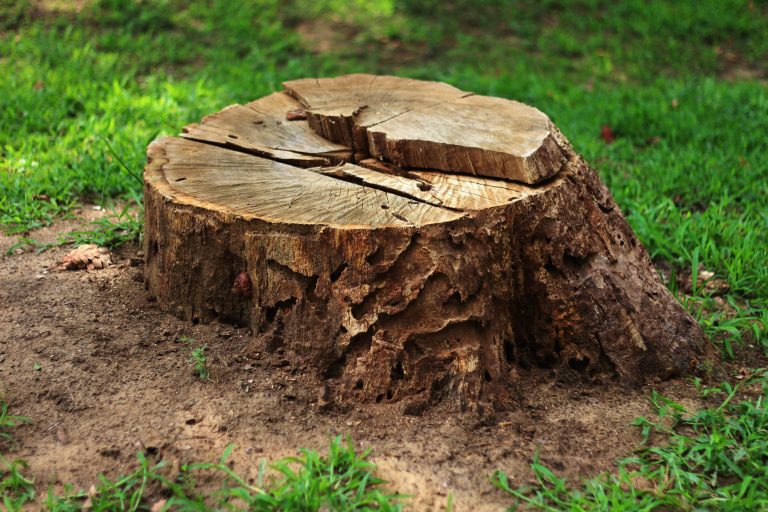
Stumps left in the ground are more than an eyesore — they interfere with drainage improvements, make ditching and grading work harder, and eventually create voids in the soil as they decompose. Stump removal is often a natural part of excavation and site work, and Mac’s Timber & Terra handles it as part of larger projects or as a standalone service.
Getting the Right Assessment Before You Start
Drainage and excavation work isn’t one-size-fits-all. What works on one Michigan property might be completely wrong for the property next door — because soil type, slope, water source, and land use all factor into what the right solution actually is.
At Mac’s Timber & Terra, every excavation project starts with a site walkthrough. We look at the terrain, the water behavior, the existing conditions, and what you’re trying to accomplish — then we give you a straight answer on what it’ll take to fix it right.
Ready to Address Your Drainage or Excavation Needs?
If you’ve got a wet field that won’t dry out, a ditch that’s grown over, a driveway that’s falling apart, or a property that needs real excavation work — Mac’s Timber & Terra is equipped to handle it.
We work across mid-Michigan with the equipment, experience, and honest approach that property owners can count on.
Contact Mac’s Timber & Terra for a free estimate.